
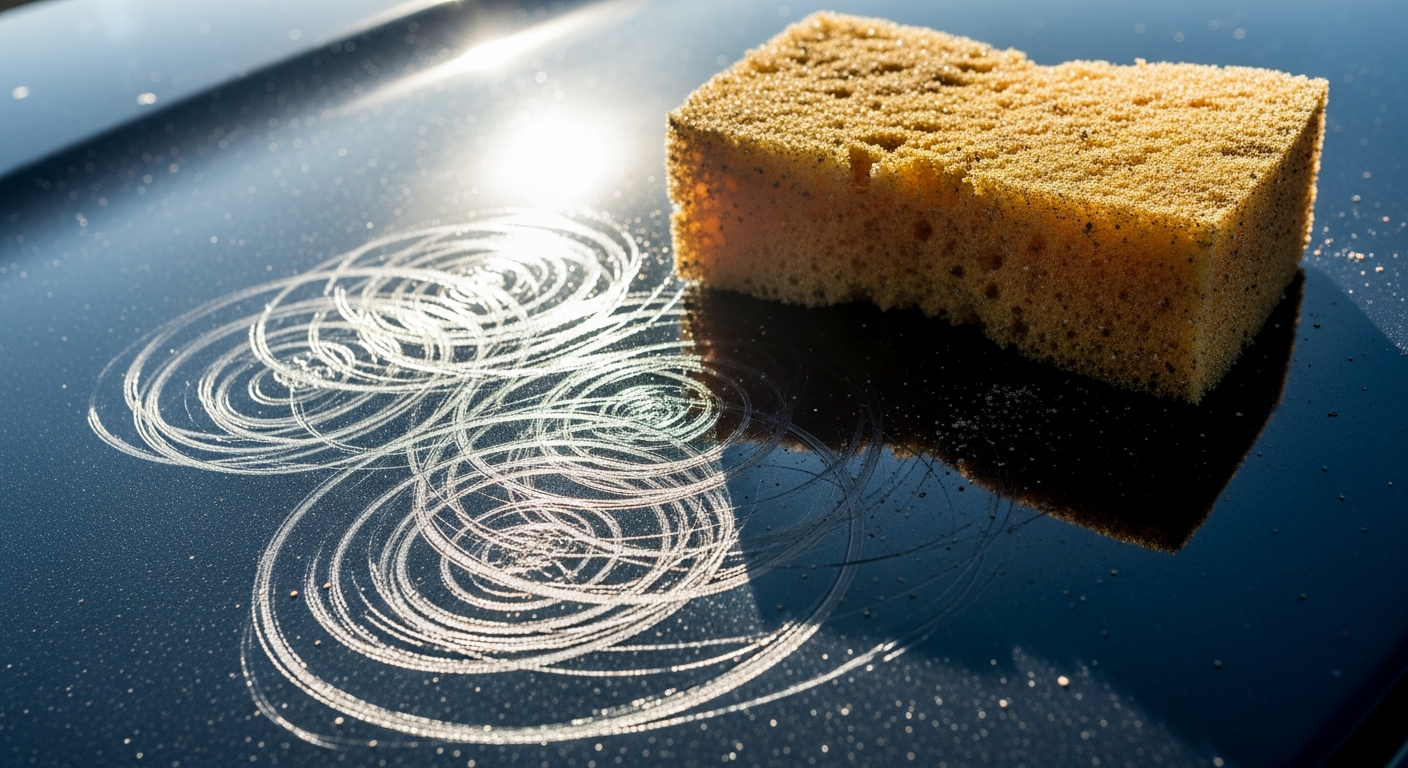
We see the damage every week. A customer brings in a car with swirl marks covering every panel, water spots etched into the clear coat, and faded trim — all caused by washing habits they thought were perfectly fine. The frustrating part is that these mistakes are easy to avoid once you know what they are.
Here are the five most common car washing mistakes we see at Ovill Car Wash & Detail, along with what to do instead. If any of these sound familiar, don’t feel bad — almost everyone makes at least one of them before they learn better.
Mistake #1: Using Dish Soap Instead of Car Wash Soap
This is the most widespread car washing myth in existence: “Dawn cuts grease, so it must be great for cleaning cars.” It does cut grease. It also strips wax, sealant, and ceramic coatings right off your paint. That’s exactly what it’s formulated to do — break down surface coatings and oils.
Every time you wash with dish soap, you’re removing the protective layer between your clear coat and the elements. In a climate like North Texas, where UV exposure is severe and summer temperatures regularly exceed 100 degrees, removing that protection means your paint is absorbing the full force of the sun with nothing between it and oxidation.
What to Do Instead
Use a pH-neutral car wash soap designed specifically for automotive paint. These products clean effectively without degrading wax, sealant, or ceramic coatings. A quality car wash soap costs $10 to $15 per bottle and lasts for dozens of washes. That’s a fraction of the cost of the paint correction you’ll need if you keep stripping your protection with dish detergent.
Mistake #2: Using a Single Bucket (or No Bucket System at All)
Here’s what happens with a single bucket: you dip your wash mitt in, scrub a dirty panel, rinse the mitt back in the same bucket, and load it up with dirty water full of the grit you just removed. Then you rub that grit-loaded mitt across the next panel. You’re essentially wet-sanding your car with its own dirt.
This is the number one cause of the swirl marks and fine scratches that make dark-colored cars look terrible in direct sunlight. Every circular scratch you see under a parking lot light came from contaminated wash media being dragged across the paint.
What to Do Instead
Use the two-bucket method. One bucket holds clean soapy water. The other holds clean rinse water with a grit guard — a plastic insert that sits at the bottom and traps dirt particles below the water line. After washing a section, rinse your mitt in the rinse bucket, scrub it against the grit guard to release trapped dirt, then dip it back in the soap bucket for a clean load of suds.
This single change will reduce the swirl marks you inflict on your own car by 90% or more.
Mistake #3: Washing in Direct Sunlight
In Ovilla, TX, finding shade can be a challenge — especially in the summer when it’s 100+ degrees and the sun is directly overhead from 10 AM to 4 PM. But washing in direct sunlight creates two serious problems.
First, soap and water dry on the surface before you can rinse them off. Dried soap leaves a film that dulls the finish and can cause streaking. Second — and more importantly — water droplets act as tiny magnifying lenses that concentrate sunlight onto the paint. This causes water spot etching: permanent marks in the clear coat that require machine polishing to remove.
Hard water makes this worse. Ellis County water has a high mineral content, and when those minerals dry on hot paint, they leave calcium and lime deposits that bond to the surface.
What to Do Instead
Wash early in the morning or in the evening when the sun is low. If your only option is midday, wash in the shade — a carport, the shaded side of your house, or under a large tree (though be prepared for additional pollen and sap contamination from the tree). Work in small sections and rinse each section before moving on, so soap never has a chance to dry on the surface.
Mistake #4: Using Old Towels, Sponges, or Chamois
That stack of bath towels in your garage? They’re destroying your paint. Bath towels are made of looped terry cloth that traps dirt against the surface and drags it across the paint with significant friction. Sponges are even worse — their flat surface provides no place for dirt particles to go, so every particle gets pressed between the sponge and your paint.
Natural chamois (the yellow leather cloths) were once the gold standard, but they share the same problem as sponges: no grit-trapping capability. They also harden over time and develop a rough texture that creates fine scratches.
What to Do Instead
Use high-quality microfiber — both for washing and drying. A microfiber wash mitt has deep fibers that pull dirt particles away from the paint surface and trap them within the nap, preventing them from scratching. Microfiber drying towels work the same way, absorbing water and trapping any remaining contaminants safely within the fibers.
Invest in a set of dedicated car care microfiber towels. Use separate towels for exterior paint, glass, interior surfaces, and wheels. Wash them separately from your household laundry (fabric softener ruins microfiber) and replace them when they start feeling flat or stiff.
Mistake #5: Ignoring the Wheels and Tires — or Cleaning Them Last
Wheels and tires are the dirtiest parts of your car. Brake dust is metallic and abrasive. Road tar, grease, and grime coat every surface of the wheel well. If you clean your wheels after washing the body — or worse, use the same mitt — you’re transferring that metallic brake dust and road grime directly onto your paint.
Many people also skip the wheels entirely, assuming the rinse water from the body wash is enough. It isn’t. Brake dust bonds to wheel surfaces and becomes increasingly difficult to remove the longer it sits. Left unchecked, it pits and permanently stains both alloy and painted wheels.
What to Do Instead
Always clean wheels and tires first, before touching the body panels. Use a separate brush and mitt dedicated exclusively to wheels — never cross-contaminate with your paint wash media. Apply a dedicated wheel cleaner, let it dwell for the recommended time, then agitate with a wheel brush to reach between spokes and into lug nut wells.
Once the wheels are clean and rinsed, set your wheel tools aside and start the body wash with fresh, uncontaminated mitts and towels.
The Cumulative Cost of These Mistakes
Any one of these mistakes might seem minor in isolation. But car washing is something you do dozens of times per year, and the damage is cumulative. After a year of single-bucket washes with dish soap and bath towels in the Texas sun, your paint will have hundreds of swirl marks, diminished protection, and early-stage oxidation that a simple wash can no longer address.
At that point, the fix is professional paint correction — a multi-hour machine polishing process that removes a thin layer of clear coat to eliminate the damage. It works, but it’s expensive, and your clear coat has a finite thickness. You can only correct so many times before there’s nothing left to correct.
The far better approach is to avoid the damage in the first place. Proper products, proper technique, and a little patience keep your paint in condition that requires only maintenance — not correction.
When Your Car Already Has the Damage
If you’re reading this and realizing your car already shows the signs of years of improper washing, that’s okay. Paint correction and a professional detail can bring most vehicles back to excellent condition. The key is to fix the damage once and then change your habits going forward so you don’t end up right back where you started.
At Ovill Car Wash & Detail, we offer paint correction, full detailing, and professional hand washing for drivers in Ovilla, Midlothian, and the surrounding Ellis County area. If your paint needs help — or if you’d rather leave the washing to someone who does it right — give us a call at (469) 571-1853.